
How ACC, Texas State, and Bastrop ISD Are Partnering on the Workforce of 2030
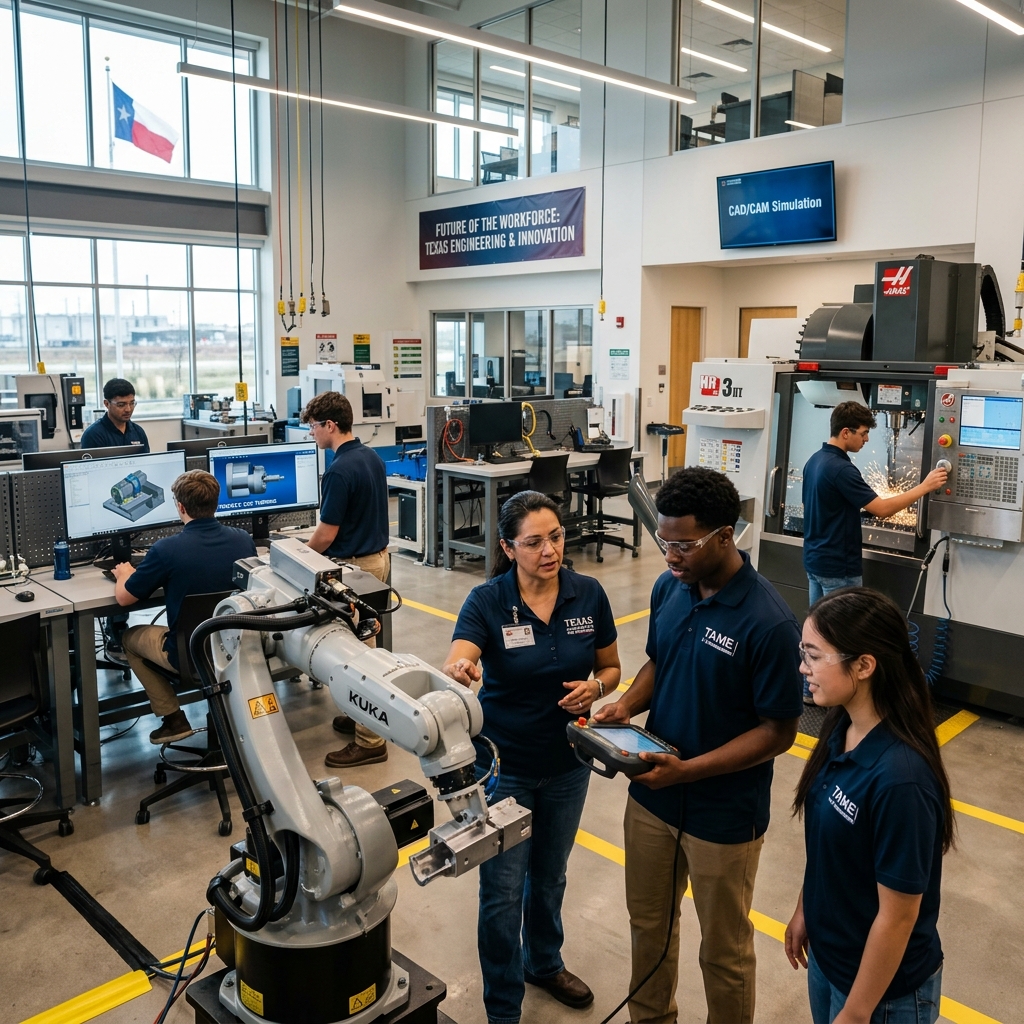
Bastrop ISD, Austin Community College, and Texas State University are building an aligned three-step talent pipeline that takes a Bastrop County eighth grader from a Career and College Exploration class through a P-TECH academy, into a free associate degree or bachelor’s at ACC Elgin, and on to a Texas State engineering, construction management, or applied technology degree. The handoffs are designed so a student never starts over and never wastes a semester. By 2030, this pipeline is what fills the high-skill jobs at EdgeConneX, SpaceX, Greenport, Wyldwood, and the rest of the Big Movers.
Why This Pipeline Matters Right Now
The Big Movers anchor projects are not arriving slowly. Construction is in the ground at EdgeConneX. SpaceX is doubling its Bastrop semiconductor footprint. Wyldwood breaks ground on its first soundstages this year. Greenport’s first phase tenants are operating. Bastrop ISD is building two new elementary schools just to keep up with population growth.
A back-of-envelope estimate of the high-skill jobs Bastrop County needs to fill by 2030 lands somewhere between 4,000 and 6,000 across construction trades, semiconductor manufacturing, data center operations, healthcare, film production, and engineering. That number does not count the indirect jobs at suppliers, restaurants, and service businesses that grow alongside the anchors.
Filling those positions cannot be done by recruiting workers from California or Atlanta. It can only be done by building the workforce locally. That requires an institutional alignment that did not exist in this region five years ago and does exist now.
The three institutions doing the work are Bastrop ISD, Austin Community College, and Texas State University. Each one has a defined role. The handoffs between them are what makes the system work.
Step One: Bastrop ISD Builds the Foundation
Every Bastrop County student’s pipeline begins inside Bastrop ISD. The district serves more than 12,000 students and is growing roughly 3.5 percent per year. About one out of every three students from pre-K through 12th grade is enrolled in a Career and Technical Education program of study.
The most important pieces of the BISD foundation:
The Career and College Exploration course. Every BISD eighth grader takes this course, which includes aptitude assessments, career research, and campus visits. By the time a student picks classes for ninth grade, they have already begun to map their interests against real career options. That is earlier than most Texas districts.
Fifteen CTE programs of study. Across Bastrop High School and Cedar Creek High School, BISD offers programs covering construction, automotive, agriculture, business, culinary arts, health sciences, STEM, law enforcement, and more. Most pathways include the chance to earn industry-recognized certifications and articulated college credit before high school graduation.
Two P-TECH academies. The Pathways in Technology Early College High School academies opened in fall 2022 and are the highest-leverage programs the district offers. The Advanced Manufacturing Academy at Cedar Creek High School prepares students for production technician roles aligned with the semiconductor and manufacturing buildout. The Health Sciences Academy at Bastrop High School prepares students for healthcare careers and includes a Pharmacy Technician Certification. Both academies graduate students with industry credentials and articulated college credit, ready to step directly into ACC degree programs or full-time employment.
Active business partnerships. The current BISD partner roster includes Tesla, Acutronic, Dovetail Custom Wood and Metal, St. David’s Health Care, Ascension Seton, and a growing list of Big Movers companies and suppliers. These are not abstract relationships. Students do internships, job shadows, and work-based learning experiences with real Bastrop County employers during the school day.
The leadership behind this work sits in BISD’s College, Career and Military Readiness office, currently directed by Raina Ellis. Her team coordinates the partnerships that make every step that comes after possible.
Step Two: ACC Bridges to a Real Career
Austin Community College is the regional bridge between high school and either a four-year degree or a workforce credential. For Bastrop County students, the most relevant pieces of ACC are the Elgin Campus and the broader dual credit and articulated credit infrastructure that lets BISD students arrive at ACC with college credit already in hand.
ACC Elgin Campus. Opened in 2013 at 1501 West US Highway 290, the Elgin Campus serves Bastrop County and parts of Travis and Williamson counties. In 2022, ACC kicked off a $25 million bond program to expand skilled trades and Advanced Manufacturing capacity at the Elgin Campus specifically. That is the workforce buildout matching the Big Movers demand profile.
Dual credit and articulated credit pathways. ACC partners with BISD to deliver college courses to high school students at no cost to the student, both at the high school campus and at ACC facilities. Students who complete approved CTE coursework at BISD with a grade of 80 or higher can earn articulated credit toward an ACC associate degree. The financial impact is significant. A BISD student who maximizes dual credit and articulated credit can arrive at an ACC degree program with a year or more of college already complete.
More than 235 associate degrees and career certificates. ACC’s program catalog covers nearly every career path Bastrop County will need to fill by 2030. Welding, electrical technology, HVAC, manufacturing, IT and networking, nursing, automotive, construction management, film production, and dozens more.
Bachelor’s degrees in workforce-aligned fields. As of fall 2023, ACC added three bachelor’s degrees: software development, manufacturing engineering technology, and cybersecurity. These are exactly the degrees the SpaceX, EdgeConneX, and Greenport anchor tenants are hiring for. ACC also offers an RN to BSN program for nurses advancing their careers.
The Smithville Workforce Training Center. SWTC, a separate but coordinated facility, serves job seekers and employers across Bastrop, Caldwell, Fayette, and Lee Counties. SWTC partners directly with ACC, BISD, and the Bastrop Economic Development Corporation to deliver industry-credentialed training and connect job seekers with hiring employers.
The ACC step is the practical bridge. A student who finishes a BISD P-TECH academy can step directly into a Production Technician role at SpaceX, or continue through ACC’s manufacturing engineering technology bachelor’s program, or transfer cleanly to Texas State for a four-year engineering degree. All three doors are open and all three are funded.
Step Three: Texas State Capstones the Pipeline
For students pursuing four-year and graduate degrees, Texas State University in San Marcos and at the Round Rock campus is the regional capstone. Three pieces of Texas State are particularly relevant to the Bastrop County workforce mix.
The Ingram School of Engineering. Five Bachelor of Science degrees, three Master of Science degrees, and three doctoral programs across electrical, mechanical, manufacturing, civil, and industrial engineering. The Ingram School operates a Cooperative Education Program in which students alternate academic semesters with paid industry semesters in their field of study. The published outcome is striking. Ninety-five percent of co-op graduates are employed full-time in their engineering field. Forty-five percent of those graduates are hired by their co-op employer.
The Department of Engineering Technology. The ABET-accredited Bachelor of Science in Engineering Technology, plus graduate programs in concrete industry management, technology management, and related applied disciplines. Sixteen technical laboratories train students in the methods used by world-class manufacturers. This is the program that produces the production engineers, manufacturing engineers, and industrial technologists who fill mid-management positions at hyperscale data centers and semiconductor plants.
The Construction Science and Management program. One of the strongest programs in Texas. Direct pipeline into the project management, superintendent, and senior estimator roles needed to oversee the $10 billion plus of construction underway across the Big Movers and the supporting infrastructure projects.
The Round Rock campus, roughly forty minutes from Bastrop, allows working students and adult learners to complete bachelor’s and graduate degrees without relocating to San Marcos. ACC associate degrees transfer cleanly into Texas State four-year programs, which closes the loop on the pipeline.
How the Handoffs Actually Work
A pipeline of three institutions is only useful if the connections are real. In Central Texas, they are.
A BISD eighth grader takes Career and College Exploration. In ninth or tenth grade, they apply to a P-TECH academy or pick a CTE pathway. By eleventh and twelfth grade, they are taking dual credit ACC courses for free, often inside their high school, and earning articulated credit for their CTE coursework.
At graduation, the student has options. They can step into a job. They can complete an ACC associate degree, which costs roughly half what most Texas universities charge and often qualifies for additional state and federal aid. Or they can transfer that ACC credit directly into a Texas State four-year program in engineering, construction science, or applied technology.
The student who takes the full pipeline can earn a four-year engineering degree from Texas State for a fraction of the cost an out-of-county student pays at a flagship university, while also having paid co-op work experience on their resume by graduation. The ones who exit the pipeline at any point still leave with credentials that match real Bastrop County jobs.
That is what an aligned regional workforce system looks like. That is what most Texas counties do not have.
Annual Anchor Events
A few specific events anchor the partnership year over year and are worth knowing about for any family with a Bastrop County student.
Bastrop ISD Youth Career Day. Held each spring at the Bastrop Convention Center, the event brings together more than 400 high school juniors and seniors and 60 plus regional employers in a single morning. Students leave with internship offers, summer jobs, and direct connections to hiring managers across the Big Movers and beyond.
ACC Dual Credit Information Sessions. Hosted virtually and in person multiple times each year for incoming and returning dual credit families. The path through this program is more affordable than most parents realize, but only if you start the conversation early.
Texas State Senior Design Day. Held annually at the Bruce and Gloria Ingram Hall in San Marcos. Local employers, including the kind of advanced manufacturers and tech companies arriving in Bastrop County, attend looking for graduating talent.
What Still Needs to Happen
The pipeline is real, but it is not yet sized to the Big Movers demand profile. A few honest gaps are worth naming.
The P-TECH academy seats are limited. The freshman cohort at each academy is in the dozens, not the hundreds, while the demand profile across the Big Movers is in the thousands. Expanding the academies is a near-term priority for BISD and the BEDC, and the new bond program that includes two new elementary schools is the leading edge of that broader expansion.
The ACC Elgin Campus, even with the $25 million bond expansion in 2022, will need more capacity to serve the next decade’s workforce. ACC’s strategic plan and bond programs continue to evolve to match.
The Texas State Round Rock campus is the right anchor for adult learners and four-year students who cannot relocate to San Marcos, but a closer Bastrop or Cedar Creek extension would shorten commutes and pull more working adults back into the higher education system.
These are solvable gaps. They require sustained partnership between the three institutions, the BEDC, the Big Movers anchor tenants, and the Bastrop County Commissioners Court that approved the abatements and 381 Agreements making the projects possible in the first place.
The Bigger Picture
The kids growing up in Cedar Creek, McDade, Red Rock, Rosanky, and Smithville are about to inherit a job market that did not exist for their parents. The institutions that train them for it are aligned, the pathways are documented, and the funding mechanisms are largely in place.
That is the quiet revolution behind the headlines. While the press covers the soundstages and the data centers and the semiconductor lines, three institutions are quietly building the pipeline of welders, technicians, nurses, engineers, project managers, and producers who will operate every one of those facilities for the next thirty years.
The world is building its future here. The kids who grew up here are about to build most of it.
Want to start the path now? Read about the twelve trades and degrees Bastrop County students should pursue right now, explore the Big Movers anchor projects that are hiring across all three institutional pipelines, or learn how the incentive stack is funding the new BISD elementary schools and ACC Elgin expansion that train the next generation.