
Water, Wastewater, and the Invisible Infrastructure That Makes or Breaks a $10 Billion Corridor
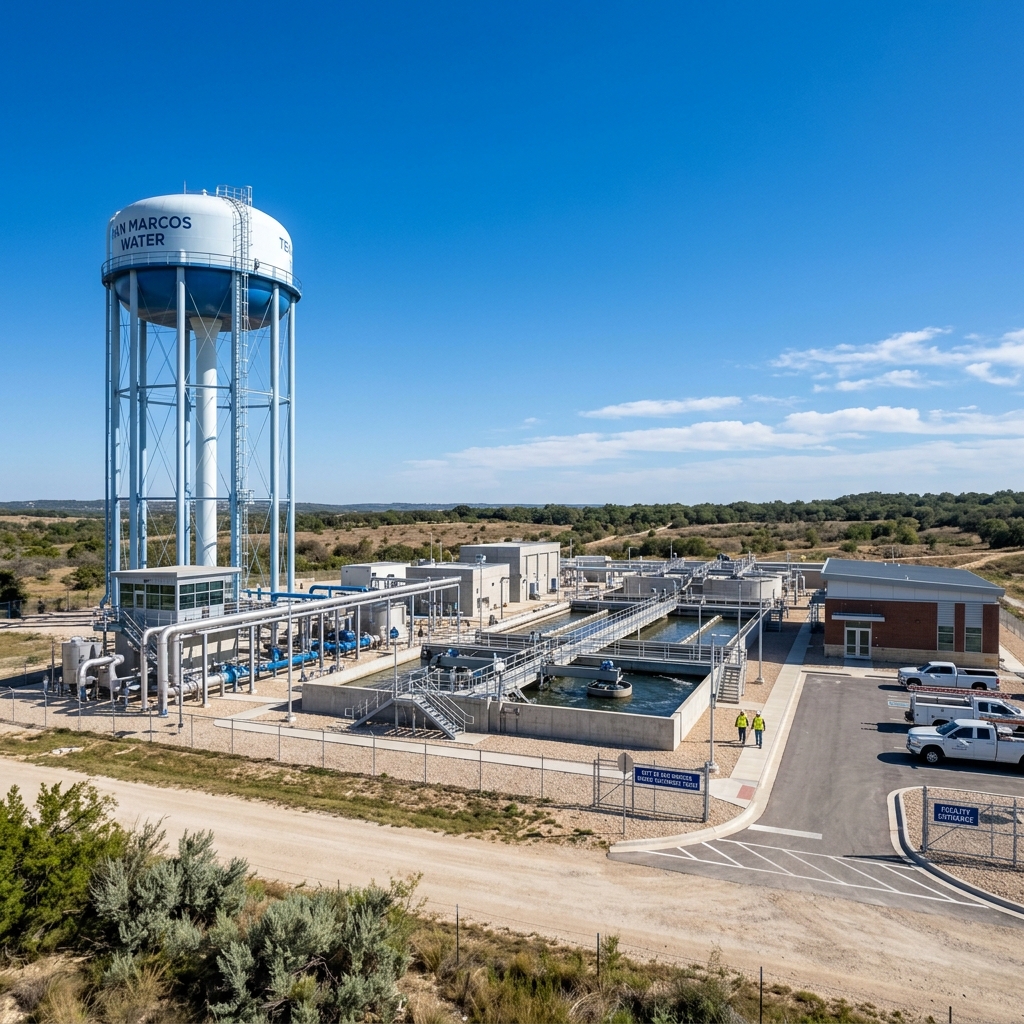
While sleek renderings of $10 billion semiconductor plants, hyperscale data centers, and sprawling film studios capture the headlines, the reality of economic development in Central Texas is buried underground. Water and wastewater capacity are the invisible constraints that dictate exactly where, when, and how massive industrial projects can be built.
In Bastrop County, solving the water equation has been the quiet, essential precursor to the “Big Movers” capital influx. Corporate site selectors do not commit billions of dollars to a region based on tax incentives alone; they commit based on utility guarantees. Here is a deep dive into how Bastrop County has engineered the invisible infrastructure necessary to support the largest industrial boom in its history.
The Thirst of the Modern Economy
The facilities driving the Bastrop County boom are incredibly thirsty.
Semiconductor fabrication plants—like the massive $10 billion Greenport campus anchoring the western edge of the county—require millions of gallons of ultra-pure water daily to clean silicon wafers during the photolithography process. Similarly, the data centers being built by EdgeConneX and others are increasingly relying on high-density liquid cooling to manage the immense heat generated by AI training clusters.
If a county cannot guarantee uninterrupted, high-volume water flow, it cannot host these industries. Period.
The Water Equation: Aqua WSC and Manville WSC
Bastrop County is not served by a single municipal water utility. Instead, it relies on a complex network of providers, primarily the Aqua Water Supply Corporation (Aqua WSC), Manville WSC, and the municipal systems of Bastrop, Elgin, and Smithville.
Proactive planning over the last decade has allowed these entities to secure the robust groundwater leases (primarily from the Simsboro and Carrizo-Wilcox aquifers) and surface water rights necessary to accommodate the influx.
But having the rights is only step one; delivering the water is step two. Recent years have seen massive capital improvements in trunk lines and elevated storage tanks along the SH 71 and FM 1209 corridors. These expansions have transformed previously un-servable, agricultural acreage into prime, shovel-ready industrial real estate.
Wastewater Capacity: The True Bottleneck
Often, the limiting factor in commercial site selection isn’t getting water to a site—it is treating the water once it leaves. Wastewater treatment capacity is notoriously expensive and slow to permit, making it the true bottleneck of economic development.
The City of Bastrop and its regional partners are currently executing multi-million-dollar wastewater treatment plant (WWTP) expansions to handle the simultaneous surge in industrial discharge and the rapidly growing residential population.
For large-scale campuses located outside municipal boundaries, the solution has been decentralization. Custom package plants and highly sophisticated on-site water reclamation facilities have become a standard feature of these massive developments. Modern semiconductor fabs, for instance, recycle massive percentages of their water internally before discharging a neutralized effluent.
The Chapter 381 Play: Making Growth Pay for Itself
Building water lines and wastewater plants costs tens of millions of dollars. The critical question for local taxpayers is always: Who is paying for this?
This is where Bastrop County’s strategic use of Chapter 381 Economic Development Agreements comes into play. Rather than the county or the city floating municipal bonds to build the trunk lines out to the greenfield sites, the agreements often require the developers to front the cost of the utility extensions themselves.
The developer builds the water lines, the lift stations, and the road improvements necessary to service their site. Once completed to municipal standards, that infrastructure is frequently dedicated back to the public utility. The developer is then reimbursed over time through a share of the new property taxes they themselves are generating. This structure ensures that growth pays for growth, protecting legacy taxpayers from footing the bill for industrial expansion.
Protecting the Colorado River
Underpinning all of this industrial expansion is a fierce commitment to the local ecology. The Colorado River runs directly through the heart of Bastrop County, serving as a recreational anchor, a wildlife habitat, and a critical water source for downstream agricultural and municipal users.
The LCRA (Lower Colorado River Authority) and the TCEQ (Texas Commission on Environmental Quality) enforce strict floodplain, runoff, and discharge regulations. The new industrial campuses are required to implement massive detention ponds, advanced stormwater management systems, and rigorous effluent monitoring to ensure that the $10 billion economic boom does not come at the expense of the river’s health.
The Foundation of the Future
Sewer lines and water towers will never be the subject of a glamorous ribbon-cutting ceremony. Yet, they are the foundation upon which the entire Bastrop County economic miracle rests.
By aggressively expanding capacity, leveraging private capital through 381 agreements, and fiercely protecting the watershed, Bastrop County has systematically removed the primary friction points for corporate site selectors. The invisible infrastructure is in place; the visible boom is the result.