
Wyldwood Studios and the Texas Film Economy: Why Zachary Levi Chose Bastrop Over Atlanta
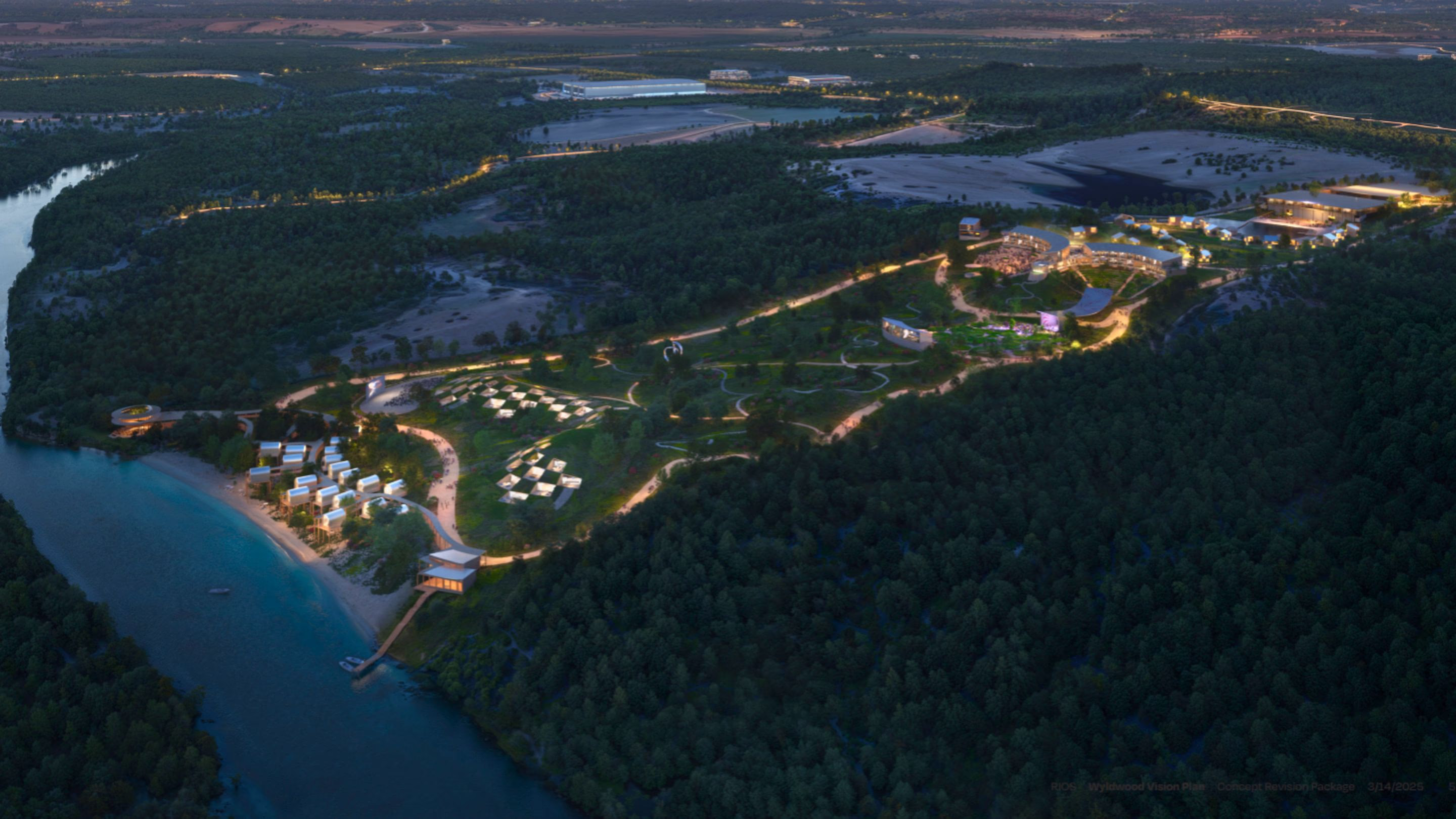
Wyldwood Studios is a 75-acre, $100 million-plus film and creative campus on the Colorado River in Bastrop County, developed by actor Zachary Levi. It chose Bastrop over Atlanta because Texas’s new $1.5 billion film incentive program now competes directly with Georgia’s, Bastrop County offers a state sales tax exemption through its Media Production Development Zone, and the Lost Pines deliver a contiguous studio, residence, and outdoor production environment thirty-three miles from downtown Austin. The location is the strategy.
What Wyldwood Actually Is
Wyldwood is not a single soundstage, and it is not a backlot. It is a multi-phase production and lifestyle campus designed to house writers, directors, crew, and cast on the same land where they shoot.
Phase one builds on 45 of the 75 acres for an estimated $111 million. The first two soundstages are scheduled to open in 2027, with construction starting in late 2025. Phase two adds a third amphitheater, additional lodging, and recreational use along the Colorado River. The completed campus will include soundstages, podcast and coworking spaces, residential cabins, an amphitheater, an onsite spa and wellness facility, and farm-to-table dining.
Project partner Trevor Hightower has described the development as multi-phased and built on a long horizon. The official Wyldwood positioning calls it a “regenerative ecosystem” anchored by production studios. In practical terms, that means a production company can write a screenplay, shoot it, edit it, host the wrap party, and put the talent up for the night without anyone leaving the property.
That is a model that does not really exist in Atlanta, in Hollywood, or anywhere else at this scale.
The Math: What Texas SB 22 Changed in 2025
For two decades, the answer to “why not Texas” was simple. Georgia paid more.
That ended in 2025. Senate Bill 22, authored by Senator Joan Huffman and carried in the House by Representative Todd Hunter, overhauled the Texas Moving Image Industry Incentive Program. The legislation directs $1.5 billion in production grants over the next six years, with $300 million every two years committed through 2035.
The economics now look like this:
- Texas TMIIIP: Up to 31% cash grant with bonuses, paid after Texas spend is verified
- Georgia film tax credit: 30% transferable tax credit, uncapped, but must be sold or applied against Georgia tax liability
- Texas crew requirement: 35% Texas residents through 2027, rising to 50% by 2031
- Texas in-state production requirement: 60% of activity must occur in Texas
- Texas minimum spend: $250,000
Two structural advantages favor Texas. First, the Texas program is a cash grant. Producers receive money directly from the state after verification rather than receiving a tax credit they have to sell to a third-party buyer at a discount, which is how Georgia’s transferable credit works in practice. Second, Texas has no state income tax on the talent, the crew, or the studio executives who relocate.
Representative Todd Hunter framed the bigger argument during floor debate: “This is Texas taking over Hollywood.” Whether or not that turns out to be the right tense, the incentive math is no longer a barrier.
The Bastrop County Layer
State incentives explain why a Texas studio makes sense. They do not explain why Bastrop specifically.
Bastrop County added its own incentive layer in 2024 by creating a Media Production Development Zone through the Texas Film Commission and the Texas Comptroller’s Office. Wyldwood’s project location can apply for designation as a qualified Media Production Location, which provides a state sales tax exemption on certain qualifying purchases over a two-year window.
That matters more than it sounds. The single most expensive line items in any production buildout are construction materials, set construction supplies, equipment, and technology. Removing the state sales tax on those purchases over a two-year construction period is real money on a $100 million project.
Notably, according to Bastrop County and the BEDC, Levi has not requested any additional tax abatements or incentives from the county or the Bastrop Economic Development Corporation beyond what the Media Production Development Zone provides. The deal is straightforward.
What the Lost Pines Offer That Atlanta Cannot
Atlanta has scale. It has a deep crew base. It has the production infrastructure built up over fifteen years of Georgia’s film boom. Bastrop has something different.
Geography on a tight footprint. The Lost Pines are the only loblolly pine forest west of the Piney Woods. Within a twenty-minute drive of the Wyldwood site, a production can stage a Civil War period piece, a contemporary thriller in a downtown square with 130-plus historic buildings on the National Register, a desert Western in the surrounding ranchland, and a river-bound adventure on the Colorado. Few film locations in North America offer that range that compactly.
Proximity to Austin. Wyldwood sits roughly thirty-three miles from downtown Austin. That is close enough to draw on Austin’s film schools, music scene, and post-production talent. It is far enough that crew members and talent can actually afford to live near the production, which is something that has become increasingly difficult around Los Angeles and Atlanta alike.
The cluster effect. Wyldwood is not arriving alone. Line204 Texas is building a $50 million-plus production base in the same county. Athena Studios is operating in Bastrop. A separate California-backed 546-acre studio project is moving through Bastrop city approvals. SpaceX, X, and the Boring Company have created a tech corridor along FM 1209 that brings advanced visual effects, AI, and virtual production talent within reach. None of those neighbors exist in Georgia.
The Film Friendly Texas designation. Bastrop has held this Texas Film Commission designation for years, which signals a streamlined permitting process and a city government that wants productions to succeed. Mayor Connie Schroeder has publicly characterized the broader studio approvals as “a business deal” for the city.
Levi’s Publicly Stated Vision
Zachary Levi has spoken extensively in public statements about why he is building what he is building.
In a statement posted to the Wyldwood website, Levi said the project must “create a place that is valuing the excellence of entertainment” and the artists making it. The framing positions Wyldwood as both a production facility and a community for the people who do creative work for a living.
In interviews with Variety covered by industry press, Levi has described Wyldwood as a response to what he sees as a structurally broken Hollywood, comparing his ambitions to the founding of United Artists by Charlie Chaplin and others a century ago, when stars built their own studio to gain creative independence. He has been publicly clear that Wyldwood is not aimed at any single ideological category of content. Levi told Variety, in reference to the popular biblical series filmed near Dallas, “We’re not making ‘The Chosen.’”
What he does appear to be making is a place where independent filmmakers, animators, podcasters, and creators can live, work, and own a piece of the infrastructure they use. That distinguishes the project from a traditional rental soundstage operation in either Burbank or the metro Atlanta region.
What It Means for Bastrop County
The Bastrop Economic Development Corporation has been straightforward about what to expect. As BEDC Business Attraction, Retention, and Expansion Manager Dori Kelley put it in coverage by Community Impact, projects like Wyldwood deliver more than film crews. They deliver tourism, ongoing investment, and a local supplier ecosystem. Small businesses across Smithville, Bastrop, Cedar Creek, and Elgin will see the ripple effect for years.
The direct numbers are real. A campus of this scale generates construction jobs during the buildout, permanent positions in studio operations and hospitality once it opens, freelance work for every production that shoots there, and a steady increase in commercial valuation on what was previously raw land along the river. Bastrop ISD is a beneficiary on the school finance side. Local restaurants, hotels, and retail are beneficiaries on the spend side. The Texas Film Commission has documented this same pattern in earlier production hubs across the state.
There is also a longer-term effect that does not show up in spreadsheets. Bastrop County is becoming a place where creative people choose to live. That changes the talent pool, the small business mix, and ultimately the local culture in ways that compound over decades. Adrian Grenier and a number of other film industry figures had already relocated to the Bastrop area before Wyldwood was announced. The trend is real, and Wyldwood is the most ambitious institutional expression of it so far.
The Bigger Texas Story
Wyldwood is one project. The Texas film economy is now a $1.5 billion bet. Hill Country Studios in San Marcos is a separate $267 million campus. Austin Studios continues to operate as a working production hub. Athena Studios, Line204, and additional projects across Bastrop County are layering capacity on top of that.
This is what an industry pivot actually looks like. Texas spent two decades watching California talent migrate to Georgia for production work. In one legislative session, the state put real money on the table, layered it with local incentives like the Bastrop Media Production Development Zone, and gave projects like Wyldwood a credible reason to plant a flag here instead of there.
That credible reason is now in the ground on the Colorado River. The first soundstage opens in 2027.
The world is building its future here. A piece of that future is going to be on screen.
Want to see how the rest of the pipeline is shaping up? Explore the Big Movers anchor projects or learn how the incentive stack is funding new schools, roads, and Emergency Services Districts across Bastrop County.