
Bastrop County's Environmental Scorecard: How Data Centers, Studios, and Fabs Are Managing Land, Water, and Air
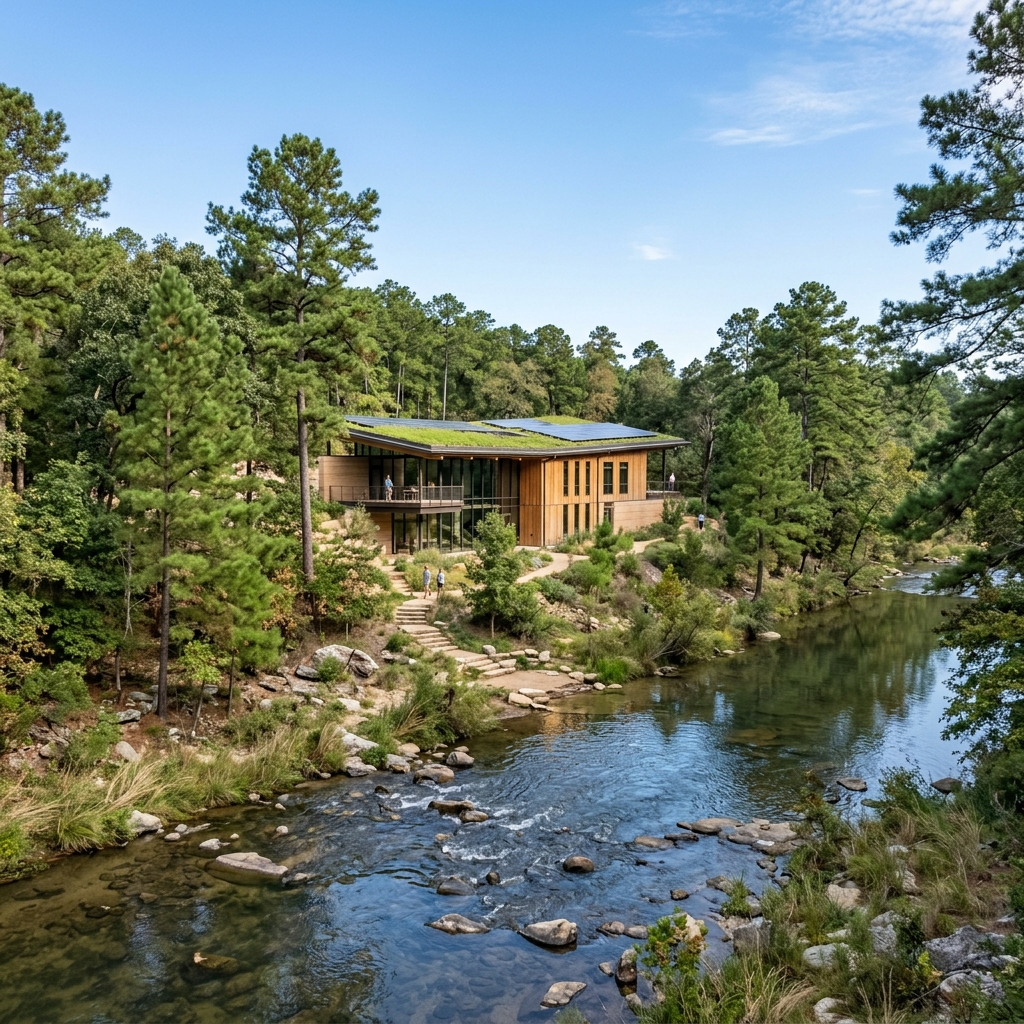
The transformation of Bastrop County into a global hub for advanced manufacturing, AI infrastructure, and film production brings an unprecedented influx of capital. But for many residents, the primary concern isn’t the economy—it’s the environment.
How does a county preserve the pristine nature of the Colorado River, the ecological uniqueness of the Lost Pines, and the clean air of rural Texas while accommodating $10 billion in heavy industrial development?
The answer lies in a rigorous framework of state permitting, localized conservation strategies, and strict environmental compliance provisions baked directly into the economic development agreements. Here is the environmental scorecard for Bastrop County’s Big Movers.
Air Quality and the TCEQ Permitting Process
Semiconductor fabrication facilities and massive data centers are highly complex operations that require strict oversight. The Texas Commission on Environmental Quality (TCEQ) serves as the primary regulator for air quality.
Before breaking ground, facilities like those planned at the Greenport campus must secure rigorous air quality permits. These permits dictate the maximum allowable emissions for volatile organic compounds (VOCs) and other byproducts of the manufacturing process. Modern fabs utilize multi-million-dollar abatement systems—essentially massive, highly advanced filtration plants—to scrub exhaust before it ever leaves the facility.
Bastrop County’s advantage is that these are new builds. They are deploying the absolute cutting edge of green manufacturing technology, operating at efficiency and cleanliness levels that older, retrofitted facilities in other states simply cannot match.
Water Stewardship and Stormwater Management
Water is the most precious resource in Central Texas. As we detailed in our previous breakdown of water and wastewater infrastructure, hyperscale data centers and semiconductor fabs require significant water volume for cooling and processing.
However, the modern standard is closed-loop efficiency. The newest data center designs utilize zero-water cooling technologies or highly efficient evaporative systems that recycle water multiple times before discharge.
Equally important is what happens to the water that falls from the sky. With 2,000 acres of new impervious cover (roofs and parking lots) across the county, stormwater management is a critical priority. Development plans must include massive retention and detention ponds to capture runoff, filter out pollutants, and release the water slowly into the Colorado River watershed, preventing downstream flooding and protecting water quality.
Preserving the Lost Pines and Wildlife Corridors
Bastrop County is defined by its landscape, most notably the Lost Pines ecosystem. The arrival of massive studio campuses like Wyldwood and Line 204 has heightened focus on conservation.
Interestingly, these projects often serve as buffers against the type of development that is actually most destructive to wildlife habitats: high-density residential sprawl.
A 75-acre film studio campus typically concentrates its heavy footprint—the soundstages and production offices—on a small percentage of the total land. The remainder is often left as natural backdrop for filming or developed into low-impact recreational space. This approach preserves vital contiguous acreage for local wildlife, maintaining natural corridors that a standard 300-home subdivision would obliterate.
The Compliance Hammer: 381 Agreements
The most powerful tool Bastrop County has to enforce environmental standards isn’t just state law; it’s the contract.
When the county utilizes a Chapter 381 economic development agreement to provide tax incentives, it gains significant leverage. These agreements routinely include strict compliance clauses. If a facility fails to meet its environmental obligations—whether that’s a TCEQ violation or a failure to properly manage its wastewater discharge—the county has the legal authority to claw back the financial incentives.
This aligns the financial interests of the corporations with the environmental interests of the community. In Bastrop County, being a good steward of the land isn’t just a PR mandate; it’s a contractual obligation tied to the bottom line.
The balance between economic growth and environmental preservation is the defining challenge of the current boom. By holding the Big Movers to the highest standards of modern sustainable engineering, Bastrop County is proving that you don’t have to sacrifice the landscape to secure the future.