
The Bastrop County Site Selection Scorecard: Power, Water, Fiber, Workforce, Permitting
The Bastrop County Site Selection Scorecard: Power, Water, Fiber, Workforce, Permitting
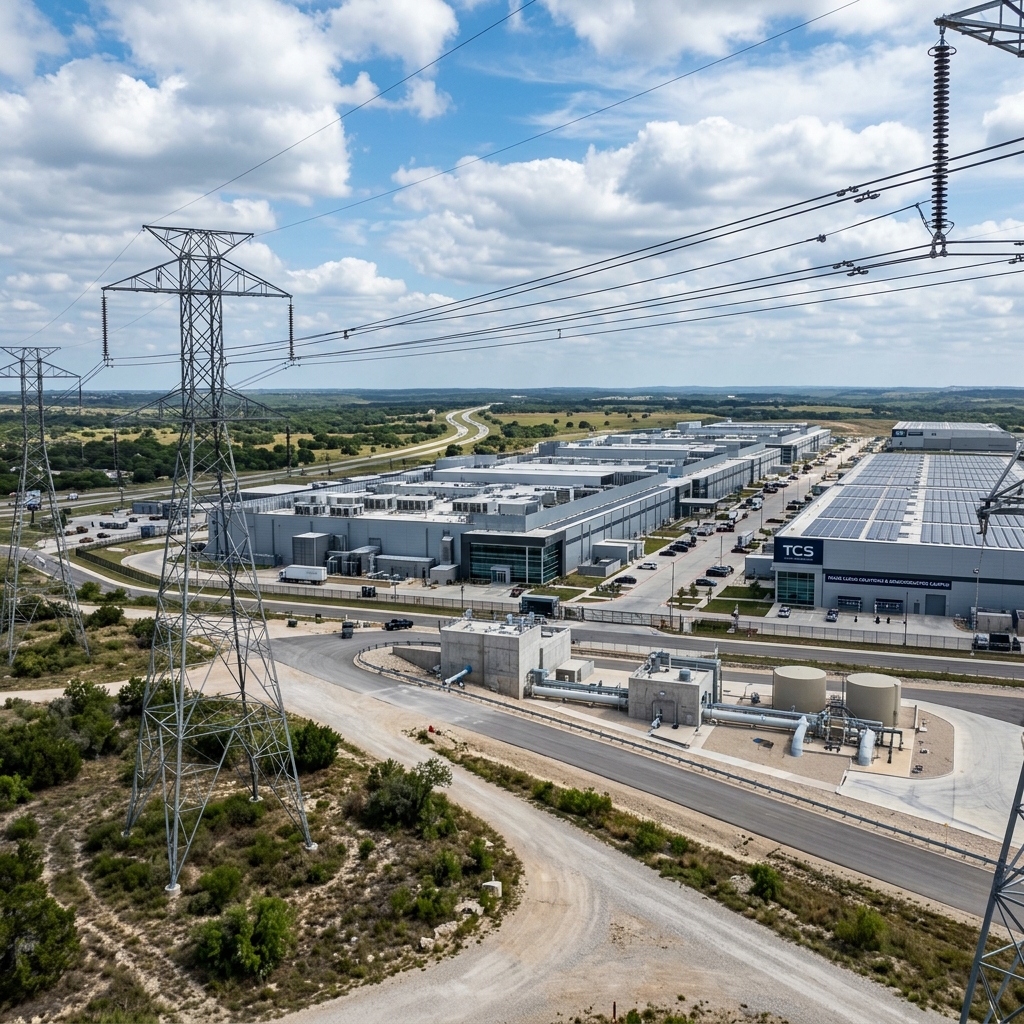
Bastrop County rates strongly on power, fiber, and permitting; competitively on workforce; and is actively building water and wastewater capacity to match the demand profile of the Big Movers anchor projects. The county’s structural advantages for hyperscale data centers, semiconductor manufacturing, and advanced production include direct ERCOT connect-and-manage interconnection, a 12,000-mile Bluebonnet Electric Cooperative grid headquartered locally, the Greenport FiberLight triple-redundant backbone, an aligned three-step BISD-ACC-Texas State workforce pipeline, and unincorporated county jurisdiction with pre-negotiated Chapter 381 Agreements. This scorecard walks through what a corporate site selector should know about each of the five dimensions.
How Site Selectors Actually Score a County
Every Fortune 500 corporate real estate team and every hyperscale data center developer uses some version of the same five-dimensional framework for evaluating a site. Power, water, fiber, workforce, and permitting are the canonical categories. Land cost and tax incentives matter, but they are increasingly secondary to whether the underlying infrastructure can actually deliver.
This post grades Bastrop County on each of those five dimensions. The structure follows what a working site selection memo looks like internally at a hyperscaler, an EPC contractor, or a real estate consultancy. Each section answers four questions:
- What does Bastrop County offer today
- What is in active buildout
- What are the honest constraints
- What should a site selector specifically ask
The point is not to claim Bastrop County is the right answer for every project. It is to give corporate site selectors a clear, defensible reference document for evaluating Bastrop County against the alternatives they are comparing.
Dimension 1: Power
Today. Bastrop County sits inside the ERCOT footprint with utility service available from Bluebonnet Electric Cooperative, the LCRA Transmission Services Corporation, and Oncor in nearby corridors.
Bluebonnet Electric Cooperative is headquartered in Bastrop County itself, on Highway 71 between Bastrop and Smithville, with its main facility at 155 Electric Avenue. The cooperative serves more than 119,000 meters across 12,000 miles of power line in 14 Central Texas counties and 3,800 square miles of service territory. Founded in 1939, it is one of the largest electric cooperatives in Texas. CEO Matt Bentke leads the organization, and the cooperative has the financial scale (annual revenues estimated between $500 million and $1 billion) to invest in transmission and substation expansions tied to specific projects.
Texas is operating one of the fastest-growing data center markets in the United States, and the structural reason is the ERCOT connect-and-manage interconnection process. The Belfer Center has identified this as one of the fastest interconnection environments in North America. Developers consistently cite the accelerated interconnection timeline as a decisive factor in choosing Texas over Virginia or other markets.
In active buildout. Bluebonnet, LCRA, and the broader ERCOT footprint serving Bastrop County are in active expansion to support the EdgeConneX, SpaceX, Greenport, and FM 535 data center projects. Texas is planning more than $30 billion in transmission upgrades statewide, and the Central Texas corridor including Bastrop County is a major beneficiary of that investment. Greenport’s published infrastructure plan includes 100% renewable electricity through utility-scale solar, integrated commercial solar and storage, microgrids, and distributed storage, plus its own Greenport Energy LLC subsidiary.
Honest constraints. ERCOT’s queue for new large-load interconnections has grown into the hundreds of gigawatts of proposed demand statewide. New projects without firm utility commitments are competing for finite slots. Senate Bill 6, signed into law in June 2025, sets new rules for very large electrical loads in Texas, including a 75-megawatt threshold for certain large-load standards. Projects above the threshold face additional scoping and review. The Austin-San Antonio corridor as a whole has 7,823 megawatts of planned capacity against just 1,154 megawatts currently operating, per March 2026 Cushman & Wakefield data, which means the queue dynamics are real even in markets with strong existing utility relationships.
Ask the BEDC. What is the current ERCOT large-load queue position for the specific transmission node serving the candidate site, what energization date can Bluebonnet, LCRA, or Oncor commit in writing, what substation expansion is in active design, and what private generation or microgrid options are available for projects above the SB 6 threshold.
Grade: Strong. Bastrop County’s power profile is one of its top structural advantages and is the reason EdgeConneX, SpaceX, Greenport, and the FM 535 data center all chose the county.
Dimension 2: Water
Today. Bastrop County is served by a mix of Lower Colorado River Authority surface water, regional groundwater conservation districts, municipal utilities in Bastrop, Smithville, and Elgin, and a network of rural water supply corporations including Aqua Water Supply Corporation. The county sits east of the Edwards Aquifer Recharge Zone, which removes one of the most significant environmental review tracks that adds time and cost to projects in Hays and parts of Travis County.
For data center applications, the dominant cooling design across the Bastrop County buildout is closed-loop chilled water with thermal storage rather than evaporative cooling. EdgeConneX’s published design specifications confirm this approach for the Cedar Creek campus. Closed-loop systems use a small fraction of the water that evaporative designs use. Industry benchmarks place a 96-megawatt closed-loop building in roughly the same daily water consumption range as a flagship Buc-ee’s travel center.
In active buildout. Bastrop County’s water and wastewater infrastructure is in active expansion alongside the Big Movers projects. Multiple municipal utility districts are coordinating with developers on infrastructure agreements, and Aqua Water Supply Corporation continues to expand service into growing parts of the county. The Greenport campus includes its own published water and wastewater infrastructure-as-a-service plan, which reduces the load on shared regional systems.
Honest constraints. Texas drought cycles are real, the Trinity and Carrizo-Wilcox aquifers have well-documented sustainability concerns, and the LCRA’s surface water allocation system imposes priority structures during low-flow periods. Any project with substantial water demand needs a documented service agreement with a utility provider that has demonstrable capacity, not a generic claim of regional availability. The honest answer for any specific candidate site is that water capacity needs to be verified parcel-by-parcel and project-by-project.
Ask the BEDC. What water and wastewater service capacity is currently available at the candidate parcel, what utility provider has jurisdiction, what service agreement terms are on offer, what cooling design is planned, what evaporative make-up volume is included, and what backup cooling provisions exist.
Grade: Developing. Water is the dimension where Bastrop County’s structural environment is strongest east of the Edwards Aquifer Recharge Zone, but specific site capacity continues to require parcel-level due diligence as the regional infrastructure scales to match demand.
Dimension 3: Fiber
Today. Bastrop County is served by multiple fiber backbone providers including AT&T, Spectrum, and Lumen, with an additional triple-redundancy fiber backbone built specifically for the Greenport campus through a joint venture with FiberLight. The Greenport fiber agreement provides redundant connectivity into Austin’s metro fiber market, which is one of the densest fiber markets in Texas.
The county also benefits from its proximity to Austin’s broader connectivity infrastructure. The 33-mile distance between Bastrop and downtown Austin is short enough to leverage the metro fiber market that supports Austin’s tech sector while sitting outside the cost and density constraints of the urban core.
In active buildout. Greenport’s FiberLight triple-redundancy plan is one of the most ambitious fiber backbone expansions in any Central Texas county. EdgeConneX’s hyperscale buildout brings additional carrier-grade fiber to the Cedar Creek corridor. SpaceX’s Bastrop facility, the Boring Company operations, and X’s Hyperloop Plaza headquarters at 865 FM 1209 have all driven additional fiber deployment in the FM 1209 corridor.
Honest constraints. Bastrop County is not Northern Virginia or Dallas. The deepest carrier diversity, peering ecosystems, and internet exchange points still sit in the urban metros. For applications that need direct connection to a major internet exchange point or single-millisecond-class latency to specific peering hubs, a Bastrop County site needs to be evaluated against a Dallas, San Antonio, or Northern Virginia alternative on its specific application requirements. For most hyperscale, AI training, and enterprise data center applications, the Bastrop fiber profile is sufficient.
Ask the BEDC and the developer. Which carriers currently serve the candidate parcel, what redundancy and diverse-path options are available, what is the latency profile to the major Austin internet exchange points, and what timeline applies to incremental fiber buildout if needed.
Grade: Strong. Bastrop County’s fiber profile is a competitive strength, anchored by the Greenport FiberLight backbone and the broader Central Texas fiber ecosystem.
Dimension 4: Workforce
Today. Bastrop County’s working-age workforce is supported by a three-step talent pipeline: Bastrop ISD (12,000-plus students, growing roughly 3.5 percent per year, with two P-TECH academies in Advanced Manufacturing and Health Sciences), Austin Community College (ACC Elgin Campus with a $25 million bond expansion in skilled trades and advanced manufacturing), and Texas State University in San Marcos (Ingram School of Engineering, Construction Science and Management, ABET-accredited Bachelor of Science in Engineering Technology).
The Smithville Workforce Training Center provides industry-credentialed training serving Bastrop, Caldwell, Fayette, and Lee Counties in coordination with ACC, BISD, and the Bastrop Economic Development Corporation. The county also benefits from the broader Austin metro workforce of more than 2 million people within a 45-minute commute, with a particularly deep talent pool in software, engineering, manufacturing, and trades.
In active buildout. Bastrop ISD’s two P-TECH academies opened in 2022 and are graduating their first full cohorts of certified production technicians and pharmacy technicians. ACC Elgin’s $25 million bond program is funding new skilled trades and advanced manufacturing capacity. Texas State has expanded engineering and applied technology programs with direct industry connections to advanced manufacturing employers.
Honest constraints. Bastrop County’s working-age population is currently around 100,000, which is small relative to the workforce demand profile of the full Big Movers at maturity. Filling all of the projected high-skill positions requires either substantial in-migration, deeper integration with the broader Austin metro labor market, or aggressive expansion of the local workforce pipeline. The county and BISD are actively building the population growth and training capacity to match, but a corporate employer evaluating Bastrop County needs to plan a realistic ramp curve rather than assume immediate availability of every skilled trade.
Ask the BEDC. What is the current available labor pool by trade and credential within a 30-mile and 45-mile radius, what is the BISD CTE pipeline for the specific roles your project will hire, what relationships are in place with IBEW Local 520, UA Local 286, IATSE Local 484, and Operating Engineers Local 450, and what employer partnership programs exist with BISD and ACC.
Grade: Competitive. Workforce is the dimension where Bastrop County’s structural strategy is sound and the institutional alignment is real, but the absolute scale of the local labor pool is still smaller than DFW, Houston, or San Antonio. The county compensates with aggressive pipeline development and proximity to the Austin metro.
Dimension 5: Permitting
Today. Major Bastrop County data center, semiconductor, and manufacturing projects are sited in unincorporated county land where county jurisdiction applies. Texas counties have limited zoning authority by state law, which means the county does not impose a city-style planning and zoning, public hearing, and council approval process on projects sited in unincorporated areas. The county still requires platting, driveway permits, fire marshal review, on-site sewage facility approval where applicable, and floodplain compliance.
The county has a documented track record of executing Chapter 381 Agreements at scale and on tight timelines. The Greenport campus operates under a unanimously approved 75 percent tax-share Chapter 381 Agreement covering 30 years across the 5,426-acre project boundary. The EdgeConneX abatement passed unanimously through the Commissioners Court. The FM 535 Cedar Creek data center moved through the same process.
For projects sited inside the City of Bastrop, the City of Elgin, or the City of Smithville, the relevant city’s planning, zoning, and council process applies in addition to the county process. For unincorporated sites, the path is materially shorter.
In active buildout. The BEDC, the Bastrop County Commissioners Court, and the various municipal economic development corporations continue to refine and expand their economic development tools. The BEDC operates as a single point of contact for site selectors and corporate real estate teams, with named accountability through Director of Tourism and Economic Development Adena Lewis and the broader BEDC team.
Honest constraints. The Bastrop County permitting environment is structurally fast for projects that fit the unincorporated, county-jurisdiction profile. Projects that require municipal annexation, water utility extension into new service areas, complex floodplain mitigation, or sensitive habitat review will face additional review tracks. Local opposition to specific projects can also influence the public process, even where it does not have formal authority to block approvals. As of early 2026, multiple Texas counties including Hood, Cameron, and various others are seeing organized opposition to data center projects, and any specific Bastrop County project should expect to engage with concerned residents alongside the formal approval process.
Ask the BEDC. Whether a Chapter 381 Agreement covering the candidate parcel already exists or is being negotiated, what is the current status of any pending zoning or municipal annexation, what fire marshal and on-site sewage facility review timelines apply, what FEMA floodplain status applies, and what local engagement and community communication strategy is recommended.
Grade: Strong. Permitting is one of Bastrop County’s clearest structural advantages. The unincorporated, county-jurisdiction model with pre-negotiated 381 Agreements has consistently delivered shorter time-to-power than the dual-track municipal-and-county environments in Williamson, Tarrant, Bexar, and Hays counties.
The Composite Picture
A corporate site selection memo on Bastrop County in 2026 would read approximately as follows.
Power: strong, with structural ERCOT connect-and-manage advantages, Bluebonnet Electric Cooperative headquartered locally, and active transmission expansion. Subject to ERCOT large-load queue dynamics that affect every Texas market.
Water: developing, with east-of-Edwards-Aquifer-Recharge-Zone structural advantages and active utility coordination on specific parcels. Subject to drought cycle and aquifer sustainability concerns that affect every Texas market.
Fiber: strong, with the Greenport FiberLight triple-redundancy backbone, multiple carrier presence, and proximity to Austin’s metro fiber market. Subject to the structural reality that ultra-low-latency applications may still prefer Dallas or Northern Virginia.
Workforce: competitive, with an aligned three-step BISD-ACC-Texas State pipeline and active employer partnerships. Subject to the absolute scale of the local labor pool, which is smaller than DFW, Houston, or San Antonio.
Permitting: strong, with unincorporated county jurisdiction, pre-negotiated Chapter 381 Agreements, and a documented track record of moving qualified projects from term sheet to vertical construction faster than the alternative Texas markets.
For projects that fit the Bastrop County structural profile (hyperscale data centers, semiconductor packaging and manufacturing, advanced production and distribution, film and entertainment infrastructure, and aerospace and defense adjacent operations), the composite scorecard rates competitively or strongly on every dimension that matters. For projects that do not fit (urban-density retail, ultra-low-latency financial trading, certain heavy industrial profiles), other Texas markets may be a better answer.
The Honest Caveats
Three caveats worth naming directly.
First, no published scorecard substitutes for direct site-specific due diligence with the BEDC, the relevant utility providers, the Bastrop County Planning Office, and the Texas Commission on Environmental Quality. The structural ratings here reflect general patterns documented in public sources. Specific project ratings depend on dozens of variables that no public document can capture.
Second, every Texas market is moving. ERCOT is changing. SB 6 is still in early implementation. New municipal regulations are being debated across the state. Any 2026 scorecard needs to be revalidated in 2027 and beyond.
Third, the Bastrop County data center, semiconductor, and manufacturing wave is concentrated in specific corridors (Cedar Creek along Highway 71, the FM 1209 tech cluster, the Wolf Lane and Greenport tracts on the north side of the Colorado River). Sites outside those corridors carry different infrastructure and permitting profiles than sites inside them.
What Comes Next for the Site Selector
For a corporate site selector or developer evaluating Bastrop County against alternatives, the practical next steps are:
- Schedule a discovery call with the Bastrop Economic Development Corporation to define project parameters and run an initial site scan
- Coordinate parallel calls with Bluebonnet Electric Cooperative, the LCRA, and the relevant municipal utilities for power and water capacity verification
- Request a Chapter 381 Agreement preliminary outline if no agreement currently covers the candidate parcels
- Coordinate a workforce pipeline assessment with BISD’s College, Career and Military Readiness office, ACC Elgin, and Texas State University as relevant to the project’s hiring profile
- Visit the operating Big Movers sites where possible to validate the structural environment in person
The county is structured to support each of these steps with named accountability and short response times. That is part of what the scorecard is measuring.
The Bigger Picture
Site selection is fundamentally a question of which county’s infrastructure, workforce, and permitting framework was built before the project arrived. Markets that wait until a hyperscale tenant shows up to figure out the answer have already lost.
Bastrop County’s infrastructure was built deliberately. The 381 Agreements were structured before the projects landed. Bluebonnet’s grid expansion was planned ahead of the load curve. The BISD P-TECH academies opened before the first SpaceX hire. The Greenport FiberLight backbone was deployed before the first major tenant signed. The ACC Elgin bond program was approved before the workforce demand peaked.
That sequencing is the difference between a county that wins major projects and a county that watches them go elsewhere. The scorecard above is the practical expression of that sequencing.
The world is building its future here. The scorecard is one of the reasons why.
Want to take the next step? Connect with the Bastrop Economic Development Corporation, explore the Big Movers anchor projects, read the companion permitting timelines comparison, or learn how the twelve trades and degrees Bastrop County students should pursue right now feed into your project’s hiring pipeline.